Saturday, December 24, 2011

Book Review: Heaven is For Real

Heaven is for real

Right up front, let me say that I think Todd Burpo’s book Heaven is for Real: A Little Boy's Astounding Story of His Trip to Heaven and Back is one of the most naive, superficial, and disturbing “Christian” books I’ve read for a long time.

In brief, the book purports to tell of a 4 year old’s journey to heaven during a surgical procedure for a severe ruptured appendix. Following the procedure, and over a period of months and years, Colton, Todd’s son, gradually “revealed” bits and pieces of his alleged journey to heaven. Here’s what he “discovered” and/or “experienced” on his journey:

  • angels sang to him while he was in hospital
  • he was sitting on Jesus’ lap while he was in heaven
  • while in heaven, he saw his father praying in a small room in the hospital and his mother in a different room talking on the phone and praying
  • he met John the Baptist in heaven
  • Jesus has a rainbow coloured horse and wears a golden crown with a pink diamond
  • he was given “homework” to do in heaven while he was being cared for by his deceased grandfather – Pop
  • everyone in heaven has wings and flies around from place to place – except for Jesus who who levitates up and down like an elevator
  • everyone in heaven has a light above their heads (Todd Burpo interprets this in the book as a halo)
  • God is ‘really, really big’ and is so big he holds the world in his hands
  • Jesus sits at the right hand of God, Gabriel sits on God’s left, and the Holy Spirit is “kind of blue” and sits somewhere in the vicinity of the other three.
  • the gates of heave are made of gold and pearls
  • after Colton’s return to earth, he became obsessed with rainbows because of the incredible number of colours he saw in heaven
  • at times, following his return from heaven, Colton saw ‘power shot down from heaven’ while his dad was preaching
  • there are swords  and bows and arrows in heaven that the angels use to keep Satan out of heaven
  • the weaponry described above will apparently be used in a coming battle that destroys the world – and Colton’s dad will be fighting in that battle
  • the final battle will be against actual dragons and monsters while the women and children stand and watch the men fighting them
  • he meets ‘a sister’ in heaven – who was lost through miscarriage by the mother years before – and which the parents claim they never spoke to Colton about
  • he claimed to see Satan in heaven but wouldn’t say what he looked like
  • and he described what Jesus looked like, comparing people’s ideas of Jesus in their artworks as not right, until he was shown a painting of Christ by Akiane Kramarik which he said got the picture of Jesus right

There are a few more “revelations” in the book, but these are the essential ones. And all this was discovered in 3 minutes in heaven!

There are a number of reasons one should be highly sceptical of this book. Firstly, Colton was just 4 years old when he began to talk about his experience mostly prompted by his father – except for the first of his comments about the angels singing to him when he was having his surgery. Four year old children are renowned for making up stories and not being able, at this age, to distinguish fantasy from reality. After all, many children have imaginary friends and use their imagination constantly in making up stories while engaging in play. It would seem that the parents are still thinking like four year olds if they take what their kid says as literally true!

Secondly, why so many months and years for the story to develop – with the prompting of the parents? Surely if a child visited heaven they’d come back and be talking about it excitedly all at once – at least to start with. Haven’t we all heard children bubble over with enthusiasm after having an exciting experience? Not Colton. He doesn’t even mention it until he happens to say something about where his parents were during his operation. But given that it takes years for his whole “story” to come out, one has to wonder how much of it was constructed in response to his father’s questioning.

Thirdly, the “information” provided by Colton is so obviously consistent with an evangelical fundamentalist view that it is not hard to see it has being informed by this culture as he grew up. Colton’s father is a pastor and he admits to reading Bible stories to Colton as he grew up. He would have attended Sunday School and  been exposed to all the detail he has described even if unconsciously. It’s not surprising that his description of heaven draws on that culture.

Fourthly, Colton’s father holds to a literalist reading of the biblical Book of Revelation which most people quite rightly understand to be highly symbolic and figurative. Colton describes things like swords and horses (rainbow coloured, no less, obviously similar to the children’s Rainbow Brite toy!) in heaven and his father believes they are truly in heaven because verses in Revelation confirm it! So does Colton’s father believe there is really a slain lamb/lion creature actually there too?

Fifthly, if Colton’s descriptions of God on thrones with angels using swords to keep Satan out of heaven are to be taken literally, then God has been caught in an Old Testament era time warp. Are they really suggesting that God has eternally sat on thrones, ridden horses, fought with swords against real dragons? Most biblical scholars (and most Christians) would have a much more mature view of these issues than the childish view that Colton and his parents have. But then, of course, according to this book, we are to become like little children in our faith and just accept all this stuff without question.

Finally, the idea that Colton has told them a few things that he just couldn’t have known about is highly unlikely. Church communities are renowned gossiping communities and it is much more reasonable to assume that he heard some of these things than to believe they are supernaturally revealed.

There’s a lot more that could be said about this book. But the above will do. Heaven is for Real is simplistic, superficial, and naive. The most disturbing thing about this book is that it has become so popular – which doesn’t say much for the people that swallow it whole without a second thought – even to the extent of stating that they have had their faith strengthened by it. If this is all it takes to reaffirm faith then, to my mind, that faith is pretty fickle.


Disclosure of Material Connection: I received this book free from the publisher through the BookSneeze®.com <http://BookSneeze®.com> book review bloggers program. I was not required to write a positive review. The opinions I have expressed are my own. I am disclosing this in accordance with the Federal Trade Commission’s 16 CFR, Part 255 <http://www.access.gpo.gov/nara/cfr/waisidx_03/16cfr255_03.html> : “Guides Concerning the Use of Endorsements and Testimonials in Advertising.”

Monday, November 28, 2011

Book Review: Surprised by Oxford

I was pleasantly surprised by Carolyn Weber's memoir Surprised by Oxford. I enjoyed it to such a degree that I had to keep reading. Carolyn, who comes from a loving but broken home and is highly averse to religion, heads to Oxford to study literature. While there, she meets all sorts of wonderful (and not so wonderful) people, engages in conversation, and is challenged by what she learns about Christianity from a friend who breaks the stereotypes she has held about believers.

The writing is a bit disjointed at times but the author uses language beautifully and describes Oxford University in ways which made me want to study there. She also shares her gradual and subtle journey from agnosticism towards Christianity. This journey sometimes includes a few cliched responses to questions that are issues for Christians but, on the whole, does not dominate the narrative.

To begin with, I wondered whether my interest could be sustained for over 400 daunting pages. But it was. With evocative descriptions of Oxford, reference to classical writers and poets, delightful turns of phrases, a bit of romance, it makes for a genuinely fresh reading experience. It's the sort of book you can relax with and be carried along on a gentle journey of delightfully meditative reflections. Beautifully honest and insightful.

Click here to learn more at Amazon: Surprised by Oxford: A Memoir


Disclosure of Material Connection: I received this book free from the publisher through the BookSneeze®.com book review bloggers program. I was not required to write a positive review. The opinions I have expressed are my own. I am disclosing this in accordance with the Federal Trade Commission’s 16 CFR, Part 255 : “Guides Concerning the Use of Endorsements and Testimonials in Advertising.”

Saturday, November 26, 2011

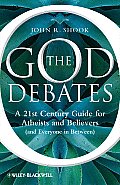
Book Review: The God Debates

John Shook's The God Debates: A 21st Century Guide for Atheists and Believers (and everyone in between) is a stunning addition to the sometimes highly volatile contemporary arguments over God that are so prominent. The author takes a serious in-depth look at just about every argument used by apologists of religion (particularly Christian) and teases them apart, describing how they are constructed, and uncovering the many flaws that make them ineffective.

Shook categorizes arguments for God in the following way:

  • Theology from the scripture - arguments for God based on special revelation and apologetics
  • Theology from the world - arguments for God derived from the natural world, morality, human experience, and human analogy
  • Theology beyond the world - cosmological arguments, teleological arguments, and arguments from the laws of nature
  • Theology in the know - Reformed epistemology, foundationalism
  • Theology into the myst - arguments based in mysticism, relativism, existentialism, and scriptural interpretation
In a section dealing with each of these categories, Shook describes the various arguments and ruthlessly analyses them and evaluates their validity - and most (if not all) of them fall short in terms of their evidence and/or logic. The final chapter presents a summary of where the God debates are now. He describes 12 modern worldviews and presents them in a diagram showing how each relates to the ones next to it and differs radically from those opposite. I've reproduced the diagram here: 

After surveying each of these and their contributions to the relationship to faith and reason - the big question in the God debates - he argues that the best possibilities for the future development of ethical principles will come from humanism - not secular or religious humanism but ethical humanism. Based on reason and experience and without the what Shook sees as the flawed supernaturalism of religious apologetics, Shook sees ethical humanism as the providing the most hope for grounding of morality in a secular culture.

The God Debates is excellent reading and both Christian apologists and atheists will benefit from this comprehensive analysis. Christian apologists will see how inadequate most of the arguments for God's existence are flawed and the challenges they need to meet if they are going to be persuasive - a very difficult task indeed. And atheists will see a model of scholarly dialogue that avoids the emotive rhetoric of the so-called "New Atheists". They will also gain a deeper understanding of the structure of religious apologetics.

The God Debates is must reading for thinking Christians and thinking atheists. It sets a standard for future dialogue around the existence and nature of God and the role of faith and reason in developing a moral framework for those who do not believe in a supernatural being. It will be challenging for both - but, in particular, Christians (and other religions) are going to have to work very hard to sustain a belief in God in the face of this author's critique. I'll be looking forward to the responses of Christian apologists to this one!

Sunday, November 20, 2011

Let's Pretend

If I may, I’d like to play a game of “Let’s Pretend”.

It is a game I like to play with various ideas just to see what would change with my faith or my paradigms if some normally accepted “givens” were removed.

If:
  • ·         Jesus was not a full 1/3 of the deity, but was completely human in every way
  •       Jesus was not born of a “virgin” and angels, stars, magi did not form part of his birth   experience.
  • ·         the miracles are more about symbolic truth than descriptions of real events
  • ·         his death was not required as a “propitiation” for our sins
  • ·         he did not physically rise on the third day

If all those things were true, then what? What are we left with?

Maybe these things:

  • ·         An extraordinary, perhaps unique man, who drew upon the collective wisdom of the Jewish faith and understood the connections of truth which had been slipping past for generations; that God was a servant God; that release of the captives, recovery of sight, release from poverty were an integral part of who God is.
  • ·         Someone who understood what God actually wanted from people;  

          “And what does the LORD require of you?
          To act justly and to love mercy
          and to walk humbly with your God.” – Micah 6:

         Or in Matthew 22: 

        “Teacher, which is the greatest commandment in the Law?”
         Jesus replied: “‘Love the Lord your God with all your heart and with all your soul and with all
         your mind.’  This is the first and greatest commandment.  And the second is like it: ‘Love
         your neighbour as yourself.’ All the Law and the Prophets hang on these two 
         commandments.”
  • ·         Someone who, when he declared forgiveness of sins did not declare it for the future (after he had paid the price, been the sacrifice, been raised from the dead and you have accepted him into your heart as personal saviour and Lord)

o   Matthew 9: 1-8 “My Son, Your Sins Are Forgiven”
o   Mark 2:1-12

He declared it as a truth.  The religious legal eagles became all bent out of shape when he said this and demanded to know how he could forgive sins. How about this; what if he wasn’t forgiving sins; he was just declaring the truth that their sins were forgiven?
  • ·         Someone who declared the current and ongoing presence of the Kingdom of God, where intimacy with the Almighty was not an event to prepare for in the hereafter, but a immediate and eternal reality.
  • ·         Someone who, with the story of the Prodigal Son, showed that God did not require a formula, a sacrifice or a ritual in order to want fellowship and a welcoming embrace. All that was required was for us to turn our face towards home and God would be sprinting towards us.


If those things were true, where would we be then?

  • ·         I would know that I live in a world where I am loved by a loving God, where I am invited to participate with that God in the healing and fulfilment of creation.
  • ·         I would know that forgiveness of my sins is not something occupying God’s heart
  • ·         I would know that God’s love for me is unconditional
  • ·         I would know that to participate in the Kingdom I need to keep my face turned towards God and to work in the areas close to God’s heart; to relieve the suffering and oppression of those around me.
  • ·         I would know that I can live now, right now, in the everlasting presence of the eternal God and trust any and all futures to Him


For these reasons and others besides, I tend to feel great freedom when theological issues are discussed. If anyone can walk up to me and scientifically prove that there was no Virgin Birth or that they have complete proof that they have discovered the bones of Jesus, it doesn't change my faith or the reality of my relationship with God in even the smallest way.

I believe that Jesus was focussed on his relationship with the Father and that this was what he wanted for everyone else. I really don’t think he wanted to be the “centre of it all.”


Tuesday, November 8, 2011

The Gathering

At the top of the South Island there is a little strip of land called Golden Bay, beloved by many as a summer holiday destination. 

It is the land of the aging hippie, the homespun wool, new age environmentalists, artists and generally cool people.

Most people travel there via the road over the Takaka Hill, a wonderful limestone/marble mountain covered in weird rock formations and astounding holes. 

Over the summer the road it is sometimes almost bumper to bumper. It is the only sealed road into and out of Golden Bay.

Most people end up congregating in a few spots – Totaranui, Takaka etc – and meeting up with their neighbours from Christchurch. Often this is a planned gathering – to get together with old friends and share a few meals and some relaxed time.

One of the questions often asked when meeting a friend is “How was the trip over the hill?” If you ever heard the reply “We didn’t come over the hill” it would initially be met with something akin to disbelief, until the thought processes kicked in.

  • ·         Perhaps they came in by ferry.
  • ·         Perhaps they arrived by helicopter
  • ·         Maybe they kayaked in
  • ·         They could have walked across
  • ·         They could have mountain biked or motor biked cross country

When you get right down to it there are heaps of ways to get to Golden Bay. It is just less common to arrive in those ways. Perhaps some of the journeys they took may even have been more fun than the one we took.

The key is that, whichever way we chose to get to Golden Bay, one way or another we all arrived for our gathering together. The path wasn’t the objective. I can’t judge whose path was the better one. The objective was to be together at “The gathering” (a little South Island, Golden Bay reference there).

In the Good Shepherd tale Jesus speaks of being the “gate” and the “shepherd”. He says the gate will open and the sheep will be called out by name into the waiting pasture. The pen is not the destination; the gate is not the destination; the shepherd is not the destination. The pasture is the destination.

Sometimes I think we spend a great dealing of time worrying about whether people have walked through the right gate; maybe even confusing the gate with the pasture.

“ I'm sorry, but I’m afraid that you simply can’t be in Golden Bay. You didn’t arrive by the road. I know it may seem like Golden Bay to you and, strangely, I also feel as if I can see you here, but I must be mistaken. There is after all only one road and, if you have not taken that road, then you are not here.”

Friday, November 4, 2011

Book Review: God Without Religion

Andrew Farley has followed up his previous book, The Naked Gospel, with another brilliant turn in God Without Religion. Farley has the gift of making profound things simple - and nothing is more in need of simplifying than religious teaching about the gospel that persists in keeping Christians in bondage.

The central point of God Without Religion is that Christians now live under the New Covenant which has jettisoned the Mosaic Law and replaced it with a new ethical foundation in the gospel of grace soaked in the power of the Holy Spirit. For Farley, many Christians have not grasped the freedom they have in Christ. They are bound up (the original meaning of the term from which religion is derived) in the oppressive belief that the have to keep the at least some of the Old Testament laws.

Of course, many will object to this message of grace plus nothing and frequently appeal to NT passages about behavior, law, and obedience. But one of Farley's gifts is to exegete Scripture and he looks at these common passages, teasing out there actual meaning in their literary and historical contexts. His explanations are clear, simple, and penetrating and I often sat breathless as I wondered why I hadn't seen these things before.

If you are living a religion that insists on defining rules or laws for you that you must live by then you must read this book. St Paul, in Galatians 5, provocatively drives home the fact that the whole point of Christ's ministry was to bring freedom. And the only way to live as a Christian is to live by the Spirit - not by being lashed to the Mosaic Law. As Farley points out, the law can only provoke us to sin. It was never intended as a tool for Christians to live their lives by. The fruits of the Spirit (love, joy, peace, and so on) are produced in us quite separate from law.

God Without Religion is a stunning second book from Farley. He uses analogies and stories to good effect; he makes the Bible come alive; and he makes controversial issues, that have plagued the church, practical and relevant. Get this book without delay and come to know God without religion.

Book details: Farley, Andrew (2011). God Without Religion. Baker Books.

Wednesday, October 19, 2011

Prophets and Losses


I have been musing for a while about scripture; where it comes from; who decides that it is scripture and how it happens that someone or some ones decides that enough is enough and now it is completed.
This has sort of bubbled forth from my annoyance at the circular arguments that scripture (of any sort) tends to generate. If one is debating or questioning some of the key issues of faith it seems to me to be odd to use the very scripture of the faith that one is discussing in order to verify the point.

Do you get what I mean?

I remember when I lived in Malaysia, that I bought a religious book by some Muslim “scholars”. I bought it because the back cover said that it was exploring the way Muslims saw Christianity in general and Jesus in particular and I thought that sounded like a good read – to have a look from someone else’s point of view.

Unfortunately all the book did was use the Koran to show how Christians incorrectly interpret the scriptures and how Christians had mistaken the role of Jesus and had deliberately changed the scriptures to suit themselves.

 This seems particularly daft to me – to use one’s own scriptures to show how wrong everyone else is. And I don’t mean to pick on Muslims in this. I think Christians are just as useful at using scriptures to prove themselves right and others (often other Christians) wrong.

But doesn’t this somehow come down to a question of whose scriptures are the best, the newest; whose have precedence?

The Christians could claim precedence over the Jews because we have the newer revelation – it supersedes the old stuff the Jews were using. The problem is that Mohammed comes along and writes the Koran and his stuff is newer than ours, so it must be better. And then, in our own strands of faith we have both new scriptures (Joseph Smith and the Mormons, Conversations with God, A Course in Miracles) and “virtual new prophets” (Martin Luther etc). So now the Mormons have the best truth and Luther sent Christianity down his true path and changed the world we live in. I suspect that the biggest error is to want to make some, one “thing” to be The Truth.

What bugs me about the whole thing is that, apparently, we can only be right with God by making others wrong and that seems very much unlike how I imagine God.

 I’ve been reading the fuss that Rob Bell’s book – “Love Wins” has created all over the place. Books have sprung up like weeds protecting the truth and condemning the falsehood. I have read book reviews where people of great faith have assured me that God really does want to condemn a whole bunch of people to be burned in eternity. 

The weirdest thing about this to me is that I wouldn’t behave like that. I would be more forgiving, more generous. I could never condemn a child of mine to eternal damnation – I would always have a way back to my heart. And, if me, then surely God?

So, I guess I have two questions:

Is there any point in playing “My prophet is better than yours”?

Why don’t we just keep on writing scripture and recognising prophets?

In the story of the Prodigal Son the bedraggled boy turned towards home with a penitent heart. While he was still far off, the Father picked up the hem of his garment and started running towards him, embracing and welcoming the boy back into the heart of the family. There was no formula the boy had to recite, no penance he had to perform, no ritual of cleansing, no agent he had to work through, no sacrifice to be made (vicarious substitution) – when the boy’s heart longed to be back with the family, the Father sprinted towards him. 

So why do we insist that God can only be approached in a certain way, through a specific path, via an agent? Couldn’t we just allow God to see us in the far distance as we turned our eyes back towards Him and allow him to gather us into his embrace?

Why so many rules?

And scripture. 
The problem with closing it off is that we immediately accept that the Divine inspiration has ended; that it was completed at a time in the past. And what that does is to turn us towards what was, when we look for God, instead of looking for what is and what could yet be.

I’d love to be part of a people of faith looking out for the voice of God in music, the word of God in what we see around us, what we hear spoken and what we read and recognising the Divine in them

Wednesday, September 28, 2011

Movie Review: The Cave of Forgotten Dreams

Werner Herzog's Cave of Forgotten Dreams is an almost spiritual experience as we enter into the life and times of ancient humans through cave paintings that are 32,000 or more years old. Using 3D technology we are taken into the Chauvet Caves of Southern France - a rare opportunity as no one else has been allowed to film in the caves.

The caves were discovered in 1994 by a group of scientists. They contain the oldest known human drawings and represent a remarkable cultural and historical find. The French government immediately realized the value of the find and sealed the caves, only allowing a small group of paleontologists and archeologists annual access to its treasures. Access is extremely constrained and small non-professional cameras with limited lighting only were allowed on the first visit. On the second, state of the art 3D cameras were used allowing the rich texture of these paintings to be shared. It is awe-inspiring to think that over 30,000 years ago someone was painting these drawings illustrating the animals and birds that were part of their world and telling stories that we now are "hearing". But we can know very little even though what has been preserved is in pristine condition. Just to enter the caves in 3D is enough though. In places it is like a cathedral and the experience, along with the haunting music of the soundtrack, provides a humbling meditative experience.

At times, the commentary is a little over interpretive and the post-script is excessively hyperbolic to the point of almost spoiling the mood of the film. The film could be shortened by cutting some of the extraneous material. But overall it provides a rare opportunity.

For some Christians, certain difficult questions will immediately arise (and most likely quickly avoided or rationalized away). Specifically, those Christians who believe in a very young earth need to deal with the fact that these paintings are over 32,000 years old and some of them even older than that. More and more evidence mounts for a very old earth and for a chronology of human history that just doesn't fit with a literalistic reading of the Old Testament. None of these issues are mentioned in the documentary but a thinking Christian will inevitably need to deal with the implications of the facts.

The Cave of Forgotten Dreams is a simple film on one level. But the 3D immerses us into what soon feels like a real visit to these caves. I recommend the visit - particularly in view of the fact that very few people will ever get to actually step inside this monumental discovery.

Positive Review
'Director Werner Herzog's latest cinematic mind trip blows you away with its beauty' - Joe Neumaier/New York Daily News

Negative Review
'Cave of Forgotten Dreams feels stuck in a middling zone of too much conjecture and not enough scholarship.' - Joshua Rothkopf/Time Out New York

AUS: G
USA: G

Friday, September 9, 2011

Movie Review: The Ledge

the ledge

The Ledge is a flawed but legitimate attempt to tell a story exploring the relationship between faith and reason – from an atheist perspective.

The story opens with Gavin (Charlie Hunnam) standing on a ledge on a tall building clearly planning to jump. Hollis (Terrence Howard) is the police officer in charge of talking Gavin down. In a series of flashbacks, we find out that Gavin has been having an affair with Shauna (Liv Tyler) who is married to Joe (Chris Wilson). Shauna and Joe are fundamentalist Christians. The mystery is what has brought Gavin to the ledge willing to jump – and it is not what you might think it is.

The writer and director, Matthew Chapman, to his credit, wrote the script and planned the movie determined to do it the way he wanted to – fully expecting not to have the movie made because of that. But it got made and it provides for thought provoking viewing even if it is somewhat amateurish in its execution.

The major problem with the movie is that it has a “preachy” flavour like so many Christian movies that offer black and white answers for complex questions. The dialogue is forced and some of the acting is artificial, although Wilson and Howard just about rescue the film with their interpretations of their characters.

Another flaw is that both the fundamentalist Christians and the atheist characters are too simplistic. The film overall is too dogmatic in its view of both and does not reflect the nuanced best of these antagonistic views. The premise of the story is brilliant and it had the potential to be a very profound piece of cinema. But, as Chapman has indicated in an interview I heard on Point of Inquiry, he wanted this to be an explicit argument from an atheist perspective. And that is what it is – an overt argument about faith and reason with cardboard stereotypes and simplistic reasoning. The “philosophical” agenda of the writer has overshadowed the story and made creative writing and professional production a secondary concern.

As a vehicle to stimulate some discussion around a number of issues, the movie has some value and there is a certain level of entertainment. But given the movie had such well known stars and was clearly backed by commercial support it is surprisingly amateurish. And the “winning” side of the argument is rigged from the beginning by comparing the best of atheism with the worst of Christianity – a poor thinking move itself.

For me, the most significant theme in the movie is whether people need God (or a belief in some external authoritative revelation of morality) in order to live good lives. I get very frustrated when I hear some Christians saying how atheists cannot have a system of moral values because they don’t believe in God. Clearly, many atheists do. They have reasons for living well and, sometimes, those reasons are based more in a care for humanity itself than some Christians who seem to merely be obeying the laws of God (as they define them) to avoid God’s displeasure. The gospel of grace subscribed to by most Christians should free them from serving for any other reason than love for fellow humans. And there is absolutely no reason to think that an atheist cannot do that.

3half-stars

Saturday, August 20, 2011

Movie Review: The Tree of Life

the-tree-of-life-movie-posterOne of the most agonizing experiences in life is crying out for meaning in the face of suffering and loss of innocence – and getting no answer from God or the universe. In the face of silence to our questions, what gives meaning to life? Terence Malik’s The Tree of Life tackles this most profound of questions.

Set in the 1950s, we follow Jack, one of three brothers, as he moves from the marvellous innocence of childhood to the loss of that innocence following his troubled relationship with his father (Brad Pitt), experience of sickness, suffering, and death, and into adulthood (Sean Penn) as he works in a competitive concrete jungle business world where the self is the only thing that matters.

The Meaning of Life is a very unusual movie. The narrative is minimal and much of the 2 hours and 19 minutes consists of impressionistic cinematography around our universe and on our earth. The experience of the story’s protagonists are almost overwhelmed by the vastness of the universe’s history from its birth to its death – once again not told in linear form but rather in frenetically wonderful glimpses that are thematically related and which build to an experience of awe-fullness in which human life is reduced to near triviality. The overall experience of the film is one of meditation and humility as Jack struggles to answer the big questions of human existence. An answer is provided at the end of the movie – there is a meaning to life – but depending on your current point of view, you may or may not agree with it. I won’t reveal it here because it will have more impact if you discover it in the ambiguity of this stunning meditation.

Many Christians provide inadequate and insipid answers to the why questions when it comes to suffering. They appeal to nonsense like ‘God has a plan for your life’; ‘This was meant to be’; or ‘We will understand the meaning of our suffering in heaven’. All of these are inadequate and, for many Christians who cry out to God in their darkest moments, become downright offensive when there is no response from God to our cries – a God that is supposed to love and care for us. It may be that this film provides the answer – whether we are Christian or atheist, religious or secular.

The Meaning of Life is definitely not a mainstream film. Don’t go to see it just because your favourite film stars are in it – you’ll be disappointed. When it was shown in an Italian cinema over one week, the first two reels of the movie were accidentally switched and no one noticed – attributing the result to the director’s editing style. In some American cinemas, signs were posted warning cinema goers ‘about the enigmatic and non-linear narrative of the movie – following some confused walkouts and refund demands in the opening weeks.’ (IMDB) That should give you an idea of the nature of this film. As one reviewer has described it, The Tree of Life is a ‘total sensory immersion’ film.

But if you are willing to immerse yourself in an almost unfathomable meditation that takes patience, courage, and perseverance to survive nearly 2 and a half hours of ambiguity and slow exploration, there is much to be pondered. The Meaning of Life reminded me of the book of Job in the Old Testament (the movie opens with a quote from the book) – except The Meaning of Life proffers a different answer and one which may be more satisfying to some. Near the beginning of the film, we are told that ‘there are two ways through life, the way of nature, and the way of grace, and we have to choose which way to follow’. If you dare to experience a completely different type of movie – go and see it and make up your mind which way you will choose.

4half-stars

Monday, August 1, 2011

Nudey Rudey

Right; let’s tackle this nudity, nakedness issue.

I admit to being a little surprised – perhaps better yet, quite stunned, with the reaction that came through when we showed the movie the other night, with two scenes of what I would consider to be very modest nudity.

I do understand how things are when we are being brought up and parents like to keep us from misunderstanding some of the racier things we might see.
 I get that and I respect that. And I do understand the respect for others that goes with that. 
But guys – we’re all grown up now.

Naked is not, of necessity, dirty. That line of reasoning leads to the burkha (burqa etc).

I exist in a state of perpetual puzzlement that we can sit happily watching a DVD which has extremes of violence of almost every kind, but we should fast forward past a female breast.  I truly don’t understand what we think God thinks about us when we do this. Watching Bruce Willis exterminate half of some large American city (and the people therein) is apparently fine with God but catching a glimpse of a person in the state they were created is somehow naughty?

So I guess I’d like to start with some of the theology of it all, a la Rob Bell.

Genesis 2:
Just two people wandering around the Garden, naked as the day they were created and pretty happy with that state of being. The essence of Genesis 2 is the unity between God and people.

Genesis 3 – The Fall (that should have big, bad, minor chords)
Apple eating and much hiding and sewing of fig leaves because they were “afraid”.

So, the shame of being naked is somehow associated with the Fall – the descent into sin if you must. 
The question then arises; are we Genesis 2 or Genesis 3 people; Fallen or living in God’s grace?
The burkha is the great acknowledgment of our perpetual dwelling in sin – no part of the female form can be displayed because men are so out of control of their sexual impulses that the only way we can be amongst women is if they are dressed as a sack. Women apparently don’t suffer from the same impulses so I am perfectly safe in my shorts and jandals.

My suspicion is that the “Importance of Beginning at the Beginning” line of reasoning is to give us a vision of how the world is supposed to be.  Jesus brought a declaration of the restoration of that existence and Revelation acknowledges the promise of the fulfilment of it.

Does that mean that I think we should all walk around naked? Not at all. We should dress properly (and preferably warmly) for whatever occasion we might encounter. Our cultural and social norms have established patterns of attire which most of us choose to conform to – no troubles with that.

What would be a good thing, in my opinion, would be for us to become comfortable with our own bodies and comfortable with the sight of other’s bodies.

One of my early points of revelation around this issue was when the chefs from St. John’s College came down to visit us a couple of years after we’d finished college and were working in ministry. Garry and Ellen were late middle-aged by then and not utterly gorgeous physical specimens by any means.  The day was bright and Akaroa-warm, the sun was wonderful on the skin. Garry told us that they were members of a naturist group and asked if we minded if they stripped off. Somewhat astonished by this we said that this was fine and they just took their clothes off and we sat around chatting and eating and having a drink. After a couple of minutes we suddenly found that it was not uncomfortable at all. It seemed surprisingly normal.

I don’t belong to a naturist group; I don’t spend much of my time wandering around naked – if I do it is generally within the confines of our own four walls. I’m fairly conservative in lots of things but I think I have figured out that nakedness is not about sexuality or sin, unless I make it that. And I choose not to.

Monday, July 18, 2011

Golden Calves


No, I speak not of my resplendent lower legs. Rather I speak of that poor bemused bovine held up as an example to all of how not to worship God.

Those poor Hebrews having struggled through seemingly endless times with an ever elusive God finally got sick of the whole thing and decided that they just wanted something they could grab hold of; something they could actually “look up to”, to be their object of worship. It really doesn’t seem too much to ask does it? It is very tricky worshipping a God that can’t be sculpted – something about us always wants the security of the “tangible”.

That got me to thinking about the whole idea of an “idol”. I mean we really give the Golden Calf worshippers a hard time about the whole false god thing but are we really any better?  Our Christian history seems to me to be a long pilgrimage from one idol to the next.

Statues of the Saints or the Blessed Virgin Mary and relics of the saints became objects of veneration and adoration because they give us something concrete to focus one. Priests became the representation of God for us, even though one of the obvious things that Jesus seemed to make clear was that there was nothing now standing between us and God. Then of course came the Reformation with Martin Luther’s wondrous claiming of the Bible for all people, not just the chosen Latin reading few. And what did we do with it? – why we made the Word of God into an idol of course!  The Word became that which we must hold on to and immerse ourselves in and, like the Golden Calf, when we remove the attention of our heart from God onto anything tangible, God becomes smaller. 

Our idols can be anything. In some personality based churches the idol is the pastor.
In some churches the idol has become “showing the fruits of the Spirit”.

I sometimes wonder if we haven’t made Jesus into an idol. When I hear the church sing “It’s all about you, Jesus”,  I wonder how Jesus would react to that. I’m not sure it would find favour.

The devil once went for a walk with a friend. They saw a man ahead of them stoop down and pick up something from the ground.
“What did that man find?” asked the friend.
“A piece of truth,” said the devil.
“Doesn’t that disturb you?” asked the friend.
“No,” said the devil, “I shall let him make a belief out of it.”

Wednesday, July 6, 2011

Proud to belong to the False Jesus Church

Some things get my head to working.

Around the corner from us, opposite the local supermarket is a church which calls itself the “True Jesus” Church. The implication is that whatever church the rest of us go to must, by process of deduction, be the “False Jesus” church. Now, I actually don't know what they believe; I've never met them and I have no right to comment on anything about them - but the name of the church started my brain cells percolating.

I started thinking about how remarkable it is how all of us seem to want to be right and often to be able to define that “rightness” by the “wrongness” of others. 

If we want, we could do a cruise around local churches and we would certainly find that many define themselves by words such as “Bible believing” or “Spirit filled” – the implication being that these qualities differentiate them from those who disbelieve the Bible and are empty of the Spirit.

This type of thing has been going on for millennia, not just in the Christian church but in every religion and in almost every aspect of life. We all want to be more right than the other guy. The gnostic religions had secret knowledge that others didn’t have and only through the possession of the secrets could one achieve entry into the inner sanctum of holiness. “Prophets” who interpret signs to give the dates of end times; who find the secret lost (or new) scriptures (Mr. J. Smith) – all these hold out the promise of belonging to the best club, of letting us become one of the 144,000 if we join the group of correct believers.

Doesn’t this all sound just like what God would do – God who so loved the world? He’d like it if the numbers who could get really close to him were very, very few, because He’s picky and a bit mean.  And that’s the message of Jesus, right? You know – the guy who seemed to think that Samaritans had a right to be accepted in God’s sight; the bloke who chatted to the social outcasts, the lepers and those that had been told over and over that they didn’t belong to the Kingdom of God.  

Wednesday, June 22, 2011

Jesus - His Name is not a Comma


My Pet Prayer Peeves.

By some miracle of space and time we find ourselves flung back to a Palestine some 1980 years ago. We stumble upon a gang of people assembled around another scruffy person, listening to him intently, asking questions and debating.

It dawns on us that we are looking at Jesus engaged in discussion with his disciples and we feel moved to address Him, to express the love and thanks we feel for all that He has meant to us. Here we go. This is our best extemporary effort.

“Precious Lord, we just really want to thank you Jesus, because, precious Jesus, you are just so amazing Lord, so truly wonderful, precious Saviour. You are the Lamb, the Almighty, the Everlasting Lord Lord……….” (this goes on in similar form for some time. The key elements are the words “just” and “really”, liberally sprinkled with various terms for Jesus and/or God all mixed together).

I have no issue with the intent behind the prayer (for thus it is), but where does our vocabulary go when we pray? We don’t talk like that to anyone else. I have this bizzare image of Jesus hearing us rabbiting on in this fashion and leaping to his feet to try to cast out the demon of “Weird Prayer Talk.”

I have the same problem with the established churches who seem to feel that, in order to pray effectively we must read from a book. Where does that come from?

 Imagine the same group of people on a mountainside and we hike up towards them and, when we eventually get to them, we pull out a book and proceed to read to Him from the book. Wouldn’t he look puzzled and start to look around wondering who we were speaking to? Why read from a book – He’s sitting right there listening to you, trying to engage in conversation.

I guess that is my peeve. I feel that prayer is about communication and discussion but we never seem to stop talking long enough for God to get a word in. If we are talking with the Creator of all things, then perhaps a sense of perspective might descend upon us and we might realise that our words might not be contributing much; perhaps our listening might be a more useful tool.


I know God hears every prayer from a grateful heart and hears it with love. But is that a good excuse to be so awful at it?

Tuesday, June 21, 2011

Dying to Live!

Firstly awesome awesome thought provoking messages that you have posted here Mr Manan-Istok!! (Amazing how they have internet in the middle east!! Haha) Thanks for sharing these thoughts with us all.

Ok so this post is in relation to one of the things that we touched on briefly at our last chat night. After hearing the stories I was then sharing about a common thread (a bit of an understatement!) I see with Jesus' teachings about how surrender = gain, and dying = living.

So lo and behold after a late Saturday night with the Jonses I ended up missing church and went up the road to do my own study time at my local cafe. I've recently taken to re-reading and studying Rob Bell's book 'Love Wins' --> Side note if you ever want a really good wrist workout try taking notes on this book!! You pretty much write it out line for line coz there's so much profoundness contained within those covers. So anyway to my surprise the chapter that I was up to was titled 'Dying to live'. I love this concept and just wanted to share a few excerpts as a refresher and in light of what we have already discussed regarding this topic:

"Jesus talks about death and rebirth constantly, his and ours. He calls us to let go, turn away, renounce, confess, repent and leave behind the old ways. He talks of the life that will come from his own death, and he promises that life will flow into us in small ways as we die to our egos, our pride, our need to be right, our stubborn insistence that we deserve to get our way. When we cling with white knuckles to our sins and our hostility we're like a tree that won't let it's leaves go. There can't be a spring if we're stuck in the fall (autumn!)"

"Lose your life and find it he says. That's how the world works, that's how the soul works, that's how life works when you're dying to live."

So I hope you enjoyed that as I just wanted to share these excerpts that I noted over an extra large mocha last Sunday. I hope that we can see in our lives opportunities where we can take up this kingdom living and follow Jesus' way, where we can see where we can surrender so ultimately we can be DYING TO LIVE!

Also a while back I wrote this down and have recently been referring to it as my little mantra. I hope it encourages you, and feel free to share in this mantra with me and we can all be mantra partners (haha I just wanted to say that coz it sounds weird!!)

Here it is:

i wanna live for something more,
i wanna live for your cause,
this life of mine i choose to give,
may i die to self so i can truly live.

Let's live our lives DYING TO LIVE!!
1love!

Monday, June 20, 2011

Are your garments spotless? Are they white as snow? Are you washed in the blood of the Lamb?”


I remember my Mum walking around the house singing some of the old hymns of her childhood. I especially remember this one

“Are you washed in the blood,
In the soul cleansing blood of the Lamb?
Are your garments spotless? Are they white as snow?
Are you washed in the blood of the Lamb?

It seemed odd to me then and it seems odd to me now to talk about washing in blood.

I know where it all comes from and how it has become such an integral part of Christian speak. It comes from the idea that Jesus was sent by God to be the sacrifice for us – to be offered up to death on a cross, to spill his blood so that we might then be seen as “spotless” before God.
Jesus was sacrificed, like a lamb or pigeon might be sacrificed; only with Him it was the biggest of big sacrifices – it meant that nothing would ever have to be sacrificed again; the price was paid, our redemption guaranteed.

This is a part of the Christian faith I have always struggled with.

I struggle with the whole idea of “sacrifice” being pleasing to God at all – “an aroma pleasing to the Lord.” (Lev 1:13).

I don’t mean the kind of sacrifice that we all know and respect as our current understanding of the term today:
-       “Their parent’s sacrificed so much to put their children through school”
-       “What sacrifices she made giving up her career to stay home with the children.”
-       “She could have been anything she wanted to be, but she sacrificed it all for a quiet life.”

These sacrifices speak of the human quality of looking beyond ourselves and beyond our immediate reward and making choices to put others first or to put other higher values first.

We are also familiar with acts of sacrifice which may have permanent repercussions – things like putting ourselves in harm’s way in order to protect children, husbands and wives etc. and being prepared to lose one’s life to preserve the life of another.

In terms of a loss to ourselves we cannot offer anything more than the offering of our life. Yet this kind of sacrifice is not even that uncommon. Most summers we read of people throwing themselves into rivers and surf to rescue others in trouble – sometimes others whom they do not even know – and losing their own lives in the process. When we read these stories we may think a lot of things:
-       “What a fool – he didn’t even know them.”
-       “Didn’t he realise he had four other children to care for?”
-       “Why would she do that when she knew she couldn’t swim well enough?”

But always, I suspect, at the very bottom of our thoughts is a respect for someone who would do such a thing and a question we ask ourselves – “Would I have the courage to do that?”

When I think of Jesus and the crucifixion I understand sacrifice in exactly that way. Jesus would rather die than deny or recant his faith in the Kingdom and the passion of his belief in the goodness of God and the all abiding presence of God’s Grace and Acceptance. I get that. I respect that and I wonder if I would have the courage to do the same, although there are many who have.

What I don’t really get is exactly how we mix that particular kind of sacrifice up with the other kind – with the kill the pigeon, bull or lamb kind of sacrifice; the “purchase” of God’s approval (forgiveness, acceptance, appeasement, favour) by killing another creature.

We know that adherents to the Jewish faith used to bring animals for sacrifice. Different animals (and birds) for different reasons and seasons  - the burnt offering, the grain offering, the sin offering, the guilt offering, the ordination offering and the fellowship offering. (Lev 7:37). And these sacrifices became an established part of the religious ritual of the Hebrew people, starting with shrines and tents and culminating in the rites and sacrifices practiced in the temple in Jerusalem.

With the destruction of the temple the general practice of sacrifice was, for the most part, halted

Even before the temple was destroyed prophets were starting to speak up about God being more interested in the sacrifices of a penitent heart.

I do understand why the early church used the symbology of this kind of sacrifice to describe the crucifixion. Clearly it spoke to the understanding of the people of the time and their understanding of how a relationship with God functioned.

At the time the early church began their thinking would have been that, for us to be “right with God”, a once for all time sacrifice had to be made; a perfect creature of ultimate value had to be brought before the altar and blood spilt. Our sins must we washed away by the blood of the Lamb. For them this idea of the substitution of one life for another had been part of their practice for hundreds of years. And the Hebrew people are not alone. Sacrifice, mostly animal, and offerings to the gods have been part of appeasement and atonement rituals for almost all peoples and religions.

However, I like to think that we are capable of learning and changing and growing. I like to think that the image we may have had of God (as reflected in some of the earlier writings in the Bible) has changed and grown as we have come to more fully understand the real nature of God. I believe that is why Jesus’ teachings were so radical – they reshaped the way we think about God.

In that light then I believe that it is worth asking this question about God; Did God ever really like those kinds of sacrifices?

When we think about the very nature of God, does it sound likely that God would like us to take small animals and kill them so that we may believe that we are in closer relationship with Him?

Does that feel right? Something about the very idea of deliberately extinguishing another created thing and spilling its life blood just to let God know how sorry we are or how happy we are or how grateful we are seems somehow abhorrent to the idea of the loving Creator.

Think of the Parable of the Prodigal Son. When the son turned around and made his way back home to the Father, was there anything standing between the two of them; a ritual that had to be performed, a sacrifice made? Or did the Father rush out to meet the son with unconditional love, without even waiting to hear the words from the boy’s mouth?

It seems to me that Jesus forgave sins before his death (without the need of the sacrificial crucifixion) – Mark 2:9, Luke 7: 47 - 50. It seems to me that he proclaimed the coming of the new age, the immanence of the Kingdom of God and the desire of God to be in relationship with us.

His crucifixion, as far as I see, is an example of sacrifice, but not the sacrifice of the “washed in the blood” variety. From my perspective Jesus had already told me that I was good with God and God was good with me and that my sins were forgiven before he ever took the walk to Golgotha.