Monday, November 28, 2011

Book Review: Surprised by Oxford

I was pleasantly surprised by Carolyn Weber's memoir Surprised by Oxford. I enjoyed it to such a degree that I had to keep reading. Carolyn, who comes from a loving but broken home and is highly averse to religion, heads to Oxford to study literature. While there, she meets all sorts of wonderful (and not so wonderful) people, engages in conversation, and is challenged by what she learns about Christianity from a friend who breaks the stereotypes she has held about believers.

The writing is a bit disjointed at times but the author uses language beautifully and describes Oxford University in ways which made me want to study there. She also shares her gradual and subtle journey from agnosticism towards Christianity. This journey sometimes includes a few cliched responses to questions that are issues for Christians but, on the whole, does not dominate the narrative.

To begin with, I wondered whether my interest could be sustained for over 400 daunting pages. But it was. With evocative descriptions of Oxford, reference to classical writers and poets, delightful turns of phrases, a bit of romance, it makes for a genuinely fresh reading experience. It's the sort of book you can relax with and be carried along on a gentle journey of delightfully meditative reflections. Beautifully honest and insightful.

Click here to learn more at Amazon: Surprised by Oxford: A Memoir


Disclosure of Material Connection: I received this book free from the publisher through the BookSneeze®.com book review bloggers program. I was not required to write a positive review. The opinions I have expressed are my own. I am disclosing this in accordance with the Federal Trade Commission’s 16 CFR, Part 255 : “Guides Concerning the Use of Endorsements and Testimonials in Advertising.”

Saturday, November 26, 2011

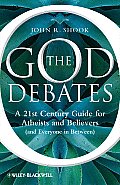
Book Review: The God Debates

John Shook's The God Debates: A 21st Century Guide for Atheists and Believers (and everyone in between) is a stunning addition to the sometimes highly volatile contemporary arguments over God that are so prominent. The author takes a serious in-depth look at just about every argument used by apologists of religion (particularly Christian) and teases them apart, describing how they are constructed, and uncovering the many flaws that make them ineffective.

Shook categorizes arguments for God in the following way:

  • Theology from the scripture - arguments for God based on special revelation and apologetics
  • Theology from the world - arguments for God derived from the natural world, morality, human experience, and human analogy
  • Theology beyond the world - cosmological arguments, teleological arguments, and arguments from the laws of nature
  • Theology in the know - Reformed epistemology, foundationalism
  • Theology into the myst - arguments based in mysticism, relativism, existentialism, and scriptural interpretation
In a section dealing with each of these categories, Shook describes the various arguments and ruthlessly analyses them and evaluates their validity - and most (if not all) of them fall short in terms of their evidence and/or logic. The final chapter presents a summary of where the God debates are now. He describes 12 modern worldviews and presents them in a diagram showing how each relates to the ones next to it and differs radically from those opposite. I've reproduced the diagram here: 

After surveying each of these and their contributions to the relationship to faith and reason - the big question in the God debates - he argues that the best possibilities for the future development of ethical principles will come from humanism - not secular or religious humanism but ethical humanism. Based on reason and experience and without the what Shook sees as the flawed supernaturalism of religious apologetics, Shook sees ethical humanism as the providing the most hope for grounding of morality in a secular culture.

The God Debates is excellent reading and both Christian apologists and atheists will benefit from this comprehensive analysis. Christian apologists will see how inadequate most of the arguments for God's existence are flawed and the challenges they need to meet if they are going to be persuasive - a very difficult task indeed. And atheists will see a model of scholarly dialogue that avoids the emotive rhetoric of the so-called "New Atheists". They will also gain a deeper understanding of the structure of religious apologetics.

The God Debates is must reading for thinking Christians and thinking atheists. It sets a standard for future dialogue around the existence and nature of God and the role of faith and reason in developing a moral framework for those who do not believe in a supernatural being. It will be challenging for both - but, in particular, Christians (and other religions) are going to have to work very hard to sustain a belief in God in the face of this author's critique. I'll be looking forward to the responses of Christian apologists to this one!

Sunday, November 20, 2011

Let's Pretend

If I may, I’d like to play a game of “Let’s Pretend”.

It is a game I like to play with various ideas just to see what would change with my faith or my paradigms if some normally accepted “givens” were removed.

If:
  • ·         Jesus was not a full 1/3 of the deity, but was completely human in every way
  •       Jesus was not born of a “virgin” and angels, stars, magi did not form part of his birth   experience.
  • ·         the miracles are more about symbolic truth than descriptions of real events
  • ·         his death was not required as a “propitiation” for our sins
  • ·         he did not physically rise on the third day

If all those things were true, then what? What are we left with?

Maybe these things:

  • ·         An extraordinary, perhaps unique man, who drew upon the collective wisdom of the Jewish faith and understood the connections of truth which had been slipping past for generations; that God was a servant God; that release of the captives, recovery of sight, release from poverty were an integral part of who God is.
  • ·         Someone who understood what God actually wanted from people;  

          “And what does the LORD require of you?
          To act justly and to love mercy
          and to walk humbly with your God.” – Micah 6:

         Or in Matthew 22: 

        “Teacher, which is the greatest commandment in the Law?”
         Jesus replied: “‘Love the Lord your God with all your heart and with all your soul and with all
         your mind.’  This is the first and greatest commandment.  And the second is like it: ‘Love
         your neighbour as yourself.’ All the Law and the Prophets hang on these two 
         commandments.”
  • ·         Someone who, when he declared forgiveness of sins did not declare it for the future (after he had paid the price, been the sacrifice, been raised from the dead and you have accepted him into your heart as personal saviour and Lord)

o   Matthew 9: 1-8 “My Son, Your Sins Are Forgiven”
o   Mark 2:1-12

He declared it as a truth.  The religious legal eagles became all bent out of shape when he said this and demanded to know how he could forgive sins. How about this; what if he wasn’t forgiving sins; he was just declaring the truth that their sins were forgiven?
  • ·         Someone who declared the current and ongoing presence of the Kingdom of God, where intimacy with the Almighty was not an event to prepare for in the hereafter, but a immediate and eternal reality.
  • ·         Someone who, with the story of the Prodigal Son, showed that God did not require a formula, a sacrifice or a ritual in order to want fellowship and a welcoming embrace. All that was required was for us to turn our face towards home and God would be sprinting towards us.


If those things were true, where would we be then?

  • ·         I would know that I live in a world where I am loved by a loving God, where I am invited to participate with that God in the healing and fulfilment of creation.
  • ·         I would know that forgiveness of my sins is not something occupying God’s heart
  • ·         I would know that God’s love for me is unconditional
  • ·         I would know that to participate in the Kingdom I need to keep my face turned towards God and to work in the areas close to God’s heart; to relieve the suffering and oppression of those around me.
  • ·         I would know that I can live now, right now, in the everlasting presence of the eternal God and trust any and all futures to Him


For these reasons and others besides, I tend to feel great freedom when theological issues are discussed. If anyone can walk up to me and scientifically prove that there was no Virgin Birth or that they have complete proof that they have discovered the bones of Jesus, it doesn't change my faith or the reality of my relationship with God in even the smallest way.

I believe that Jesus was focussed on his relationship with the Father and that this was what he wanted for everyone else. I really don’t think he wanted to be the “centre of it all.”


Tuesday, November 8, 2011

The Gathering

At the top of the South Island there is a little strip of land called Golden Bay, beloved by many as a summer holiday destination. 

It is the land of the aging hippie, the homespun wool, new age environmentalists, artists and generally cool people.

Most people travel there via the road over the Takaka Hill, a wonderful limestone/marble mountain covered in weird rock formations and astounding holes. 

Over the summer the road it is sometimes almost bumper to bumper. It is the only sealed road into and out of Golden Bay.

Most people end up congregating in a few spots – Totaranui, Takaka etc – and meeting up with their neighbours from Christchurch. Often this is a planned gathering – to get together with old friends and share a few meals and some relaxed time.

One of the questions often asked when meeting a friend is “How was the trip over the hill?” If you ever heard the reply “We didn’t come over the hill” it would initially be met with something akin to disbelief, until the thought processes kicked in.

  • ·         Perhaps they came in by ferry.
  • ·         Perhaps they arrived by helicopter
  • ·         Maybe they kayaked in
  • ·         They could have walked across
  • ·         They could have mountain biked or motor biked cross country

When you get right down to it there are heaps of ways to get to Golden Bay. It is just less common to arrive in those ways. Perhaps some of the journeys they took may even have been more fun than the one we took.

The key is that, whichever way we chose to get to Golden Bay, one way or another we all arrived for our gathering together. The path wasn’t the objective. I can’t judge whose path was the better one. The objective was to be together at “The gathering” (a little South Island, Golden Bay reference there).

In the Good Shepherd tale Jesus speaks of being the “gate” and the “shepherd”. He says the gate will open and the sheep will be called out by name into the waiting pasture. The pen is not the destination; the gate is not the destination; the shepherd is not the destination. The pasture is the destination.

Sometimes I think we spend a great dealing of time worrying about whether people have walked through the right gate; maybe even confusing the gate with the pasture.

“ I'm sorry, but I’m afraid that you simply can’t be in Golden Bay. You didn’t arrive by the road. I know it may seem like Golden Bay to you and, strangely, I also feel as if I can see you here, but I must be mistaken. There is after all only one road and, if you have not taken that road, then you are not here.”

Friday, November 4, 2011

Book Review: God Without Religion

Andrew Farley has followed up his previous book, The Naked Gospel, with another brilliant turn in God Without Religion. Farley has the gift of making profound things simple - and nothing is more in need of simplifying than religious teaching about the gospel that persists in keeping Christians in bondage.

The central point of God Without Religion is that Christians now live under the New Covenant which has jettisoned the Mosaic Law and replaced it with a new ethical foundation in the gospel of grace soaked in the power of the Holy Spirit. For Farley, many Christians have not grasped the freedom they have in Christ. They are bound up (the original meaning of the term from which religion is derived) in the oppressive belief that the have to keep the at least some of the Old Testament laws.

Of course, many will object to this message of grace plus nothing and frequently appeal to NT passages about behavior, law, and obedience. But one of Farley's gifts is to exegete Scripture and he looks at these common passages, teasing out there actual meaning in their literary and historical contexts. His explanations are clear, simple, and penetrating and I often sat breathless as I wondered why I hadn't seen these things before.

If you are living a religion that insists on defining rules or laws for you that you must live by then you must read this book. St Paul, in Galatians 5, provocatively drives home the fact that the whole point of Christ's ministry was to bring freedom. And the only way to live as a Christian is to live by the Spirit - not by being lashed to the Mosaic Law. As Farley points out, the law can only provoke us to sin. It was never intended as a tool for Christians to live their lives by. The fruits of the Spirit (love, joy, peace, and so on) are produced in us quite separate from law.

God Without Religion is a stunning second book from Farley. He uses analogies and stories to good effect; he makes the Bible come alive; and he makes controversial issues, that have plagued the church, practical and relevant. Get this book without delay and come to know God without religion.

Book details: Farley, Andrew (2011). God Without Religion. Baker Books.